
Charting the Adjacent Possible
Future explorations for Space Syntax as a sociospatial theory

In preparation for the panel about the much-anticipated launch of Bill Hillier’s selected papers in a book edited by Laura Vaughan, John Peponis and Ruth Conroy Dalton, Kimon Krenz posed a challenging question: "Bill Hillier positioned space syntax as more than just a descriptive theory – he saw it as explanatory and predictive of social processes. However, critics argue that space syntax still struggles to fully capture complex social dynamics such as power relations, cultural conflict, or social inequalities. Vini, how might space syntax theory evolve to robustly address these complexities, and could this open the door for new interdisciplinary dialogues that fundamentally reshape our understanding of space and society?”
Answering such a question is, of course, a tall order. This essay brings a longer response that supported my brief communication during the live event. A de facto proper response to Krenz’s question will require an even longer article stating the basic premises and definitions, and carefully pursuing the derivation and implications of the thoughts laid down here.
A first question triggered by Krenz’s provocation is: why should we expand space syntax as a sociospatial theory? Space syntax does what it does well, with real contributions to both social and urban theories. However, there are arguments to be made for continuous work on the theory. First, social and material reality changes, as new events happen bringing ripple effects, and as social, political and technological processes move on, possibly requiring reflection in theory. Also, new knowledge is produced, opening up new possibilities of explanation, which in turn may inspire, or suggest potential connections with and responses from space syntax, along with theoretical and empirical spaces for space syntax to contribute to. A theory might keep moving in dialogue with emerging ideas, theories, and paradigms across different disciplines so that it can continuously attract engagement. An approach that keeps changing might increase its chances of staying relevant, avoiding possible pitfalls of a ‘normal science’, in Thomas Kuhn’s (1962) sense.
There are other necessary questions: Where is space syntax now? What are the lines of potential progress? What has space syntax left to be understood? These are the kinds of questions that deserve attention and discussion across research communities (see Krenz et al., 2024). We should be aware ("word of advice I”) that there is a risk in bringing transformations to a theory through concepts that do not belong to its core and are what might be called ad hoc transformations. They might destroy the integrity of an original theory and render it unrecognisable. We should also be aware ("word of advice II”) that the object domain of a coherent theory naturally tends to relate to possibilities (and choices) of concepts in theory formation and, a step further, to its empirical possibility of grasping phenomena under scrutiny. This particularly seems to be the case for space syntax as a theory with testable propositions — more so than for previous theories in urban studies, with the possible exception of works in urban economics.
This implies the search for commensurability between theory and the represented world – a theory whose explanatory reach, complexity and conceptual machinery are in appropriate proportion to the phenomena and evidence it addresses, a theory that does not reach beyond what can be observed or tested. That search is more hardly achievable by theoretical propositions oriented to grasp broad structures in reality, of course. We have to make room for the fact that such theoretical constructions are in fact not just approximations and simplifications of reality, but also to some extent reifications — giving seemingly concrete content and form to otherwise elusive, socially-produced phenomena — since such structures are likely to exist rather as traces (cf. Giddens, 1984; Latour, 2005).
Think of usual constructs such as ‘social class’: one can hardly see its existence or boundaries in reality, other than grasp traces of its existence in the form of income levels, occupational positions or lifestyles and, perhaps, statistical aggregations around such factors. The insightful exploration of Durkheimian social solidarities in space syntax follows a similar condition: they seem hardly demonstrable as such (see Netto, 2016). However, we still need this kind of large-scale, structure-oriented theorisation in order to understand the world — even if it implies risks of some level of reification, which must be carefully reduced, ideally to non-existent. My main point here is that theoretical expansion in space syntax would do well in avoiding the pursuit of theoretical claims that empirical work cannot back up, as the scientific inquiry evolves. That said, commensurability can grow with new methodological advances and new data sources. The ‘takeaway message’ is to search for commensurability.
A last word of advice would be to bear in mind my limitations and biases as a theorist, which are unavoidable to anyone facing bodies of knowledge and reality, as one is able to apprehend them. I will guide my observations by a concept proposed by evolutionary biologist Stuart Kaufmann (1995): what is actual now enables what is next possible – the adjacent possible. This idea was insightfully anticipated on morphological grounds by Hillier and Leaman (1975/2025:84) as morphogenetic time: “the successive appearances of new forms, in which the next was possible only because the last had occurred”. The adjacent possible relates naturally to a deeply statistical and configurational imagination where one thing not only leads to another — it may lead to many others in a next round and even more in the next. The creation of new entities from previous ones easily exponentiates over time, increasing the diversity of what can happen next, yet is conditioned by what happened before. For instance, segregation concepts triggered new concepts in a deeply configurational fashion, combining existing ones and incorporating explorations across disciplines (Netto et al., 2024). I use ‘adjacent possible’ to mean the set of theoretically plausible but not yet realized extensions of space syntax concepts (such as ‘social categories’) and phenomena (such as ‘encounter'), meaning the possibilities they open (such as additional social processes that can be triggered once encounters exist) and how we could access them.
What lies in the adjacent possible for space syntax as a socio-spatial theory? I will chart several trajectories, starting with the micro-level of social groups woven into everyday life, and then scaling up to larger-scale social dynamics that constitute the main focus of this discussion.
1. Group contact and the politics of encounter
Urban structures work as “mechanisms for generating contact” (Hillier, 1988/2025:330). Contact and co-presence are central social features in space syntax and beyond (e.g. Giddens’ social integration theory), along with probabilistic interfaces of social categories and the ‘awareness of others’, especially between inhabitants and strangers (Hillier et al., 1983; Hillier and Hanson, 1984) – but also between men and women, adults and children, social classes and so on (Hillier et al., 1993). What are the extensions of concepts such as social contact, interface, and categories?
One path is phenomenal: the adjacent possible of social interfaces involves deeper dives into social difference, group contact and group formation, along with possibilities for interaction and social experience — closer and closer to socially-oriented individual behaviours. These are not necessarily local or micro-scale social processes, since group formation may transcend local spatial scales, but they certainly require a very close look within social interaction between socially different individuals or groups, and within organic and mechanical solidarities (see Liebst and Griffiths, 2020). Another path is epistemological: where is social theory in that sense now? We may find ongoing research lines that can both support and inspire research in space syntax, as well as benefit from it. I will bring a few possibilities. A full account of how these approaches could be methodologically integrated with space syntax – or how their phenomena might be examined through a syntactic lens – would require a systematic treatment that lies beyond the scope of this essay.
Intergroup contact
There is a field active since the 1950s in Social Psychology, Intergroup Contact Theory, which aims to explain people as members of social groups rather than isolated individuals (Allport, 1954; Vezzali and Stathi, 2016). It asks why “us” versus “them” distinctions arise, how they guide prejudice, conflict and cooperation and how those dynamics can be changed. This implies research on the dynamics of social homophily and anxiety in the hypothesis of the effects of contact: prejudice drops when members of different groups interact under equal status, common goals, cooperation and authority support (Pettigre and Tropp 2006). It is also a surprisingly non-spatial field. One can easily think of spatiality as a generator and mediator of intergroup contact. Building connections with intergroup contact theory could enable explorations of contact between different identities in social group formation, segregation and desegregation – say, from schools to neighbourhoods and whole cities. Research possibilities include the role of cities and urban areas over the frequencies and forms of cross-group positive and negative contact, and their effects over perceived stereotypes, misinformation echo-chambers and cultural threat; group conflict and majority–minority power relations. Social and spatial behaviour within and between groups can be observed or simulated with social identity-based rules in relation to syntactic properties and configurational affordances.
Intersectionality: Configurations of social groups
The connections of co-presence and social categories interface in space syntax enable potential explorations with the experiences between different groups in the complex dynamics of social life dealt with in intersectional studies. Intersectionality refers to the contact and overlapping of aspects of social groups, such as race, ethnicity, class, gender, sexuality, (dis)ability, and geographical location (e.g. Crenshaw, 1989; McCall, 2005; Carbado et al., 2013). Intersectional studies see these categories as inherently relational, as the meaning of each one shifts depending on the configuration of their relationships. These phenomena have deep political and ethical implications, as they address issues of social justice and how democracy is enacted in social practices. There are avenues for syntactic approaches in the form of the role of space in intersectionality and inclusiveness, e.g. the spatial dynamics of group formation and opportunities for experiences of different social identities, incorporating systemic spatial descriptions in connection with small-scale localised studies. The urban experiences of different identity groups and individuals are indeed worthy of syntactic exploration.
The politics of encounter
These possibilities reassert the centrality of contact and those silent spatially-inscribed restrictions on contact, which is how structuralist sociologist Linton Freeman (1978), who first developed the measure of betweenness centrality, conceptualises segregation. An adjacent possible of a spatial theory of encounter patterns and interfaces of social categories would be a comprehensive incursion into the fabric of social groups, fields, lifestyles and positions and their interfaces, as people participate in multiple social identities immersed in the flows and tensions of contact and restrictions on contact. It would do well to include the challenges, particularly vulnerable groups such as immigrants, ethnic minorities, disabled groups, the elderly and many more. These would be spatial incursions into “overlapping otherness” and the “politics of difference” (Young, 1990) as a feature of “the politics of encounter" where group-specific realities are recognised along with the challenges of between-group exposure and interaction. To be sure, work on these connections can be seen growing within the space syntax literature (e.g. Vaughan, 2018; Rokem and Vaughan, 2019; Toprak and Ekdi, 2022; Sailer, 2024; etc.).
Bridging the “quantitative-qualitative divide”
These possibilities suggest a path that space syntax itself synthesises: inherently hybrid, qualitative-quantitative approaches, encompassing apparently incompatible fields, from anthropology to graph theory. Seen from the perspective of human geography, sociology and other interpretive disciplines, however, space syntax has been reduced to a quantitative approach (cf. Liebst and Griffiths, 2020). Explorations of the spatial conditions of social interfaces, intergroup contact, and intersections of social experiences in group exposure and formation could reclaim that path in a wider fashion. I am particularly curious about bridges between space syntax and ethnographical work, mapping trajectories in the ‘transformations of community’ passage from ‘virtual communities’ (Hillier et al. 1983) to sociospatial behaviour of different social groups. I still wish to highlight the importance of investigating the fabric of such social worlds, exploring syntactic spaces and spatial behaviour.
Now we can shift our attention to the spectrum of adjacent possibilities in the direction of broader social processes.
2. Scaling up: toward structural social processes
I wish to draw attention to some approaches that are particularly apt for probing large-scale, fully articulated structural social processes and hold promise for an enriching dialogue with space syntax.
Relational sociology
Interestingly from a configurational point of view, this growing field aims to de-objectify society by treating persons, groups and institutions not as bounded entities but as ongoing bundles of relations within configurations, ties and flows (Emirbayer, 1997). Social organisation emerges from configurations of interaction. The field seeks to show how durable social forms (roles, markets, organisations, identities) crystallise out of repeated interaction patterns. Actors are nodes-in-networks, not standalone carriers of attributes. Approaches favour processes over states; social causes lie in sequences and trajectories, not independent static variables (Abbot, 2001). There is a focus on ‘configurational causation’: outcomes arise from joint effects of multiple, interdependent ties in processes seen as ‘dual emergence’: agency and structure co-evolve. Repeated encounters create macro-forms that, in turn, shape future encounters (Emirbayer and Mische, 1988). However, mind that meanings are subjects in this field: situated meanings are not encoded in individuals but negotiated across relational contexts. Notwithstanding, there seems to be potential for syntactic dialogues with such strongly temporal approaches.
Social and spatial networks
There is a long path of exploration of social networks in space syntax. Not only are networks at the heart of configurational reasoning, society has been frequently theorised as social networks (e.g. Hillier and Hanson, 1984; Hillier and Netto, 2002) and approached in analytical and empirical work (e.g. Sailer and McCulloh, 2012). There is still much to be done to integrate spatial networks and social networks, including broader topological descriptions of urban systems as activity systems articulated with and energised by the properties of street networks. Network-based descriptions of cities as both spatial and activity systems can provide the nodes of articulation to social networks and clarify the role of space in their formation. Of course, social attributes (e.g. identities, nature of contacts) can be added to such descriptions.
The adjacent possible of societies as encounter systems
Now I wish to explore a different path. My work has searched the adjacent possible of probabilistic encounter systems — in the direction of a full description of society as systems of actual interactions. That means moving from the spatial conditions of encounter patterns to the description of a social system where agents communicate and exchange contents mediated by architectural and urban space — from how enormously diverse individual actions amount to cooperation systems immersed in divisions of labour, to non-instrumental interactions and sociability (Netto, 2007; 2008). How are these action and interaction frameworks mapped into syntactic space? Given “the primacy of syntactic structure over semantic representation” (Hillier and Hanson, 1984:49) and a central physical concept of space based on ‘generic function’ (see Hillier, 1996), that would be a challenging construction. A system of interaction involves differentiated exchanges whose organisation, if it is to be actively mediated by space, requires a level of differentiation of space close to that of actions.
The Information Continuum

In my scientific work, I have searched for a full material theory of society as a system of interactions. That means moving from a view of societies as systems of encounter to a view of social systems where agents communicate and exchange information mediated by architectural and urban space. This massive interaction system includes how enormously diverse individual actions amount to cooperation systems immersed in divisions of labour, non-instrumental interactions, and sociability (Netto, 2007; 2008).
How does it fare when we compare this aim with a well-known material theory of why and how societies produce cities and urbanise space, such as Hillier et al.'s Space Syntax? How are the information-based interaction frameworks I wish to address mapped into physical space? Given “the primacy of syntactic structure over semantic representation” (Hillier and Hanson, 1984:49) and a central physical concept of space based on ‘generic function’ (see Hillier, 1996), that would be a challenging construction. A system of interaction involves differentiated exchanges whose organisation, if it is to be actively mediated by space, requires a level of differentiation of space close to that of actions.
Let us use space syntax as a departure point and a concept proposed by evolutionary biologist Stuart Kaufmann (1995): the “adjacent possible". What is actual now enables what is next possible. Faced with conceptual boundaries, I would argue that the adjacent possible of a ‘society as an encounter system’ goes hand in hand with the adjacent possible of the syntactic concept of space. An obvious path involves an idea of ‘social labels’ or ‘social meanings in buildings’ — a ‘semantic space’. Of course, meaning has been mostly exogenous to space syntax. However, the semantic condition was systematically considered in an insightful article, “The Architecture of Architecture” (Hillier and Leaman, 1975; see Peponis, 2025). Perhaps one of the problems with meaning — other than the fact that “it is not easy to deal scientifically with meanings” (and I am ironically paraphrasing Freud on ‘feelings’) — is that it seems external and hence, artificial and ad hoc to physical space. Semantics and meaning in social contents are understood to be clearly materially distinct from the physical world — one ‘signified’ and the other ‘tangible’. So meaning is seen as radically different from syntactic space because of their different manifestations.
This is an epistemological issue first and foremost. Epistemological traditions reassert such differences as meaning is frequently seen as a cognitive content seemingly floating over and touching the material — say, in the form of associations (Netto, 2008). But what if we could explore a different concept able to handle material and semantic differences as part of a phenomenal spectrum? In fact, there is a concept growingly recognised as central to both things — from being stored in the deepest arrangements of organic molecules in genetic codes as the DNA mapped in Biology to the deepest arrangements of matter in Physics (e.g. Hidalgo, 2015): information. Information seems able to manifest across different materialities and media. Information takes different forms, or can be interpreted and decoded in different media.
The spectrum of social information – or, physical information and beyond
The term ‘syntactic information’ appears only once in The Social Logic of Space (p.100), but the idea of space encoding social information is inherent to space syntax — and explicitly so (e.g. space syntax as “a descriptive theory of how spatial pattern can, and does, in itself carry social information and content", p.xi; see pages 39, 142, 154, etc.; “configurational information” appears in Hillier and Netto, 2002/2025:569). So space syntax can be said to not only recognise the existence of information, aligned with the emerging paradigm of information across the sciences, but also see built space as social information. Here lies an adjacent possible worth pursuing.
Much information in urban space is physical, but is all information in space physical? How do we consider, for instance, land uses? ‘Land uses’ are pragmatic descriptions of human activities and practices performed in buildings and spaces, but they can hardly be denied as ‘social information’. Of course, we should not make the mistake of thinking that there is only syntactic information or that all spatial information in an urban environment is syntactic. As much as cognition is situated and extends into the environment (Clark and Chalmers, 1998), spatial information is part of the environmental information required for humans to perform (see Passini, 1992; Neisser, 1994). Humans seem to explore different means of generating information in space to build socially useful information and informationally useful environments, i.e. environments able to hold a sufficiently large spectrum of information needed for our material and symbolic reproduction.
My argument is that physical information is part of such a continuum of information — a range within the spectrum of spatial information, which in turn is a part of the spectrum of environmental information, which is part of the spectrum of social information.
But what exactly is the nature of syntactic information, and how does it fit into such a spectrum? We can start by saying that it is produced by social cognitive beings that create culture and intelligibility in their symbolic and material environment, exploring different languages. Hillier et al. (1976; 1983) and Hillier and Hanson (1984) have theorised that built space is part of such languages: a morphic language with limited vocabulary, different from ‘natural languages’, which have rich vocabularies associated with meaning. We learned that such language materialises through distributions of partitions and open spaces within and between buildings.
The brilliant innovation here was to see not only the ‘shape’ as information, something to some extent seen in architectural aesthetics and semiotics, but fundamentally the sequencing and topologies of spaces as coding social information. Frequencies of entities can indeed encode information. That is a basic tenet of Shannon's (1948) revolutionary theory of information. So space syntax is also aligned with the powerful means of reading the world that is information theory. The ‘restrictions on random processes’ at the heart of syntactic theory can be seen as a morphogenetic version of the ‘reduction of entropy’ seen by Shannon as fundamental to the emergence of languages as intelligible codes — to be sure, also critical in biological and physical processes (see e.g. Prigogine's work on entropy and the dissipation of structures — Prigogine and Stengers, 1984).
One can even imagine a representation of syntactic frequencies and topologies as binary codes or other limited, elegant representations. For instance, I have myself explored a binary representation of urban form using cellular versions of Nolli maps to decode information from building footprints (Netto et al., 2023), to find that spatial information can also be found in the combinatorial arrangement of cells, overlapped with syntactic information.
If spatial information subsumes syntactic information, how do we access spatial information that is more volatile than syntactic information? Frequencies in built space can encode information with social effects. We also know that its vocabulary is limited, way smaller than what other means of information in natural languages can produce through what is ordinarily called ‘meaning’. We can expand this thought to consider that meaning is, in fact, inherent to and embedded in practice — and enacted as such (see Wittgenstein, 2001). Now, the fact that our actions produce information implies that our activities in space are also informational and become associated with spaces. This argument brings back the information contained in those land uses mentioned above. This semantic information produced by activities in buildings and places matters because it is not always intrinsic to physical space: in cases where the generic function is the case in the syntactic organisation of buildings, there is a natural limit to the social information embedded in physical space. I argued that, precisely in these cases, there is an increasing need for semantic information enacted in such places for their spatial information to be socially useful (Netto, 2007:83-90; 2016).
Note that this is fully consistent with the idea that “[t]he structured information on which the [social] system runs is not carried in the description mechanism but in reality itself in the spatiotemporal world” (Hillier and Hanson, 1984:44). We can consider that there is environmental information of which spatial information is part; that there is syntactic information, that is part of spatial information; that there are other forms of social information in space which we enact as our activities take place and become associated with such places.
So information is very diverse in form, nature and intensity. However, we can imagine a way to arrange forms of information as that continuum, not going as far as to consider information in matter (from a Physics viewpoint) or genetic information in organisms (in Biology) – even though this could probably be done (see Hildalgo, 2015) — but the information humans produce as social information. We can lay down forms of social information in a simple conceptual way if we consider a spectrum based on ‘stability', from the most stable forms of information to the most volatile and elusive forms of information. So we would have a spectrum from social information in built space to social information in actions and speech. There are other information media, such as written language, visual media, the internet, etc., which we may suspend in this sociospatial scheme. A visual metaphor can help us, where every possible different information content is represented by a colour (Figure 1).
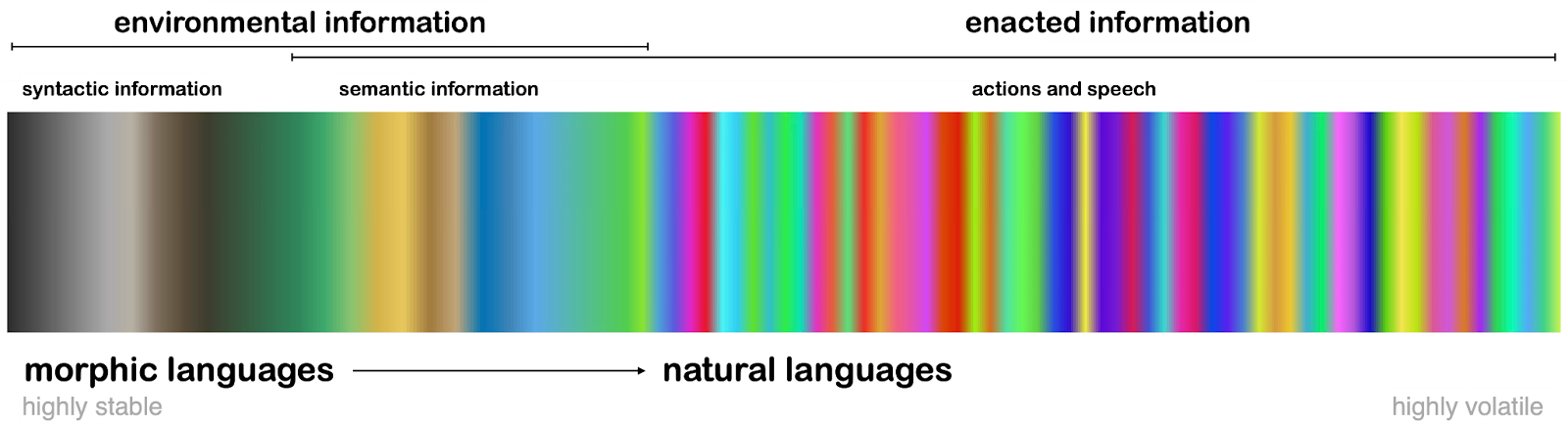
It makes sense that the more physical and stable social information is, the more limited its basic codes are; and the more volatile, the more diverse it gets, in the form of actions and speech that fade in time-space as immediately as they appear. The elusive materiality of actions and speech allows information to diversify enormously. Societies need the full material spectrum afforded by different media, and indeed have explored them throughout their trajectories (think of the role of computing and communication technologies in our contemporary globalised society). Of course, this is an illustrative representation of an information spectrum.
The central idea is that information transcends material differences and is an encompassing phenomenon. Essentially, everything either becomes, contains or can be represented as information. We can suspend for a moment the material vehicle of information and bypass the epistemological problem of dealing with physical space and meaning in space. We can encompass adjacent forms of spatial information and the unstable and high-frequency social information of actions within a single phenomenal and conceptual framework.
Now we need to take a step further in the direction of interaction systems. Social theory suggests that sociability and social reproduction are rooted in producing and exchanging information through action and communication (Habermas, 1984). Let us try a visual approach to reach this step by bending the band of colours representing the spectrum of social information into a ring. If we recognise syntactic information as part of a broader spectrum of information that agents read not only to take part in encounter systems but also engage in communicative exchanges, we may recognise that spatial information ‘informs’ communicatively exchanged information (Figure 2).
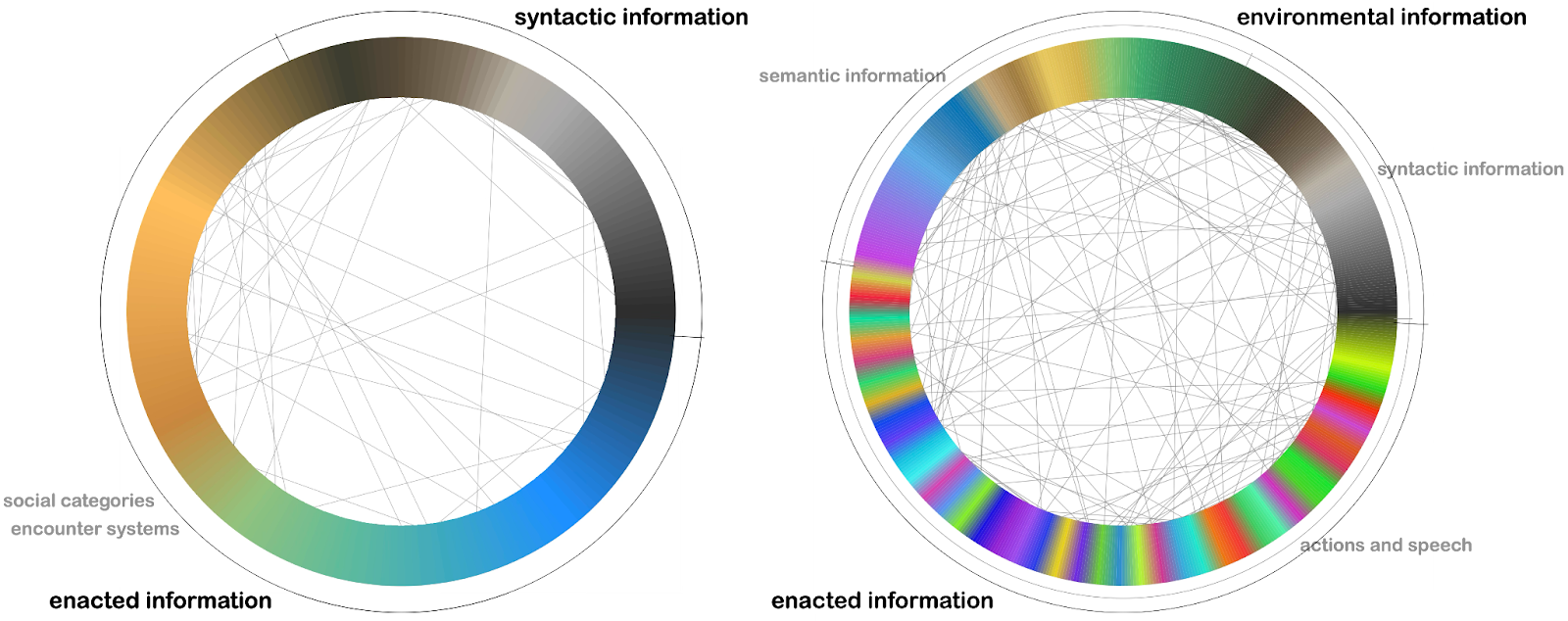
The number of edges between information units increases dramatically when considering more social information in space and actions. This conceptual scheme allows us to see the tremendous explosive configurational and combinatorial gains that more information units add to a society to express itself materially and use urban space to structure their internal interactions and communication. Nevertheless, the former ‘ring’ helps to structure the latter.
Overcoming the dualism of meaning and physical matter
We need theories to describe how that happens. On conceptual grounds, we need to reach a description of the society-space relation closer to the actual complexity of informational exchanges at the heart of social organisation and reproduction. Besides working out the introductory framework above, the main challenge is methodological: how can we reach a theory commensurate with its empirical dimension? Here, the quantification of information can help. The mathematical treatment in information theory can deal with qualitative differences (e.g. Mackay, 1969; Floridi, 2009; Haken and Portugali, 2015; Netto et al., 2018). Since Shannon’s theory, different forms of information can be quantified.
Thus, the qualitative or semantic spectrum of spatial information can be addressed rigorously, avoiding the black boxes of subjective interpretations. One is also left to imagine how such a path would dialogue with Hillier and Leaman's (1975) ‘semantic algebra’ if it were further developed (see Peponis, 2025). These would probably be exciting means to overcome the dualism of meaning and physical matter in general and the semantic-syntactic divide in sociospatial theory in particular.
Final thoughts
While preparing these notes for the launch of Bill Hillier’s third book – not the monograph he pursued two decades ago when I was his student, but a volume that gathers and re-situates four decades of seminal articles – I found myself returning to the question of how a theorist searches for the adjacent possible. Few authors across the social sciences embody that idea as fully as Hillier. Working inside the conceptual framework he forged with colleagues, yet in constant dialogue with diverse disciplines and an ever-changing empirical world, he has always leaned toward the frontier of what could come next. The adjacent possible was not simply an analytical horizon for him; it was a place he appeared to inhabit.
If research is the continual exploration of that horizon, the challenge is to keep theory restless – always in conversation with new times, new spaces, new technologies and bodies of knowledge. I would argue that the mark of a living theory is precisely this relentless search for the adjacent possible.
Acknowledgement: This essay grew out of the remarks I delivered at the launch of Bill Hillier’s book at The Bartlett School, University College London, on May 7th, 2025. Although its structure follows my original presentation, I have expanded the argument to include explanations, references, and clarifications that an oral format could only hint at, and to address questions raised in the subsequent discussion. I am especially indebted to Kimon Krenz for his characteristically challenging question; to the editors Laura Vaughan, John Peponis, and Ruth Conroy Dalton; and to all the panellists and participants. I also thank Miguel Serra, John Peponis, and Kimon Krenz for their valuable critical feedback.
A previous version of this essay was published in:
Vaughan, L. (2025) Bill Hillier’s legacy, and the future of Space Syntax – notes from the Space Syntax book launch.
To cite this essay:
Netto, V.M. (2025). Charting the Adjacent Possible: Future explorations for Space Syntax as a socio-spatial theory. In: Bill Hillier’s legacy, and the future of Space Syntax – notes from the Space Syntax book launch (Vaughan, L., 2025, ed), UCL Press. https://uclpress.co.uk/bill-hilliers-legacy-and-the-future-of-space-syntax-notes-from-the-space-syntax-book-launch/
References
Abbott, A. (2001). Time matters: On theory and method. University of Chicago Press.
Allport, G. W. (1954). The Nature of Prejudice. New York, NY: Addison-Wesley.
Carbado, D. W., Crenshaw, K. W., Mays, V. M., & Tomlinson, B. (2013). Intersectionality: Mapping the Movements of a Theory. Du Bois review: social science research on race, 10(2), 303-312.
Crenshaw, K. (1989). Demarginalizing the Intersection of Race and Sex: A Black Feminist Critique of Antidiscrimination Doctrine. University of Chicago Legal Forum, 1989: 139–168.
Emirbayer, M. (1997). Manifesto for a relational sociology. American journal of sociology, 103(2), 281-317.
Emirbayer, M., & Mische, A. (1998). What is agency?. American journal of sociology, 103(4), 962-1023.
Floridi, L. (2009). Philosophical Conceptions of Information. In Formal Theories of Information: From Shannon to Semantic Information Theory and General Concepts of Information; Sommaruga, G., Ed.; Springer-Verlag: Berlin; pp. 13–53.
Freeman, L. C. (1978). Segregation in Social Networks. Sociological Methods & Research, 6(4), 411–429. https://doi.org/10.1177/004912417800600401
Giddens, A. (1984). The constitution of society: Outline of the theory of structuration. Univ of California Press.
Habermas, J. (1984). The Theory of Communicative Action, Vol . 1. Polity Press, Cambridge.
Haken, H, & Portugali, J. (2015). Information Adaptation: The Interplay between Shannon Information and Semantic Information in Cognition. New York: Springer.
Hidalgo, C. (2015). Why Information Grows: The Evolution of Order, from Atoms to Economies. Basic Books: New York, NY.
Hillier, B. (1988). ‘Against enclosure’. In: Teymur, N., Markus, T. and Wooley, T. (eds), Rehumanizing housing. London: Butterworth, 63–88.
Hillier, B. (1996). Space is the machine: A configurational theory of architecture. Cambridge: Cambridge University Press.
Hillier, B. and Leaman, A. (1975). ‘The architecture of architecture: Foundations of a mathematical theory of artificial space’. Hawkes, D. (ed.), Models and systems in architecture and building. Hornby: Construction Press, 5–28.
Hillier, B. and Hanson, J. (1984). The social logic of space. Cambridge, Cambridge University Press.
Hillier, B., Hanson, J., Peponis, J., Hudson, J. and Burdett, R. (1983). ‘Space syntax: A different urban perspective’. The Architects’ Journal, 178(48), 47–54, 59–63.
Hillier, B. and Netto, V. (2002). ‘Society seen through the prism of space: Outline of a theory of society and space’. Urban Design International, 7, 181–203.
Hillier, B., Penn, A., Hanson, J., Grajewski, T. and Xu, J. (1993). ‘Natural movement: Or, configuration and attraction in urban pedestrian movement’. Environment and Planning B: Planning and Design, 20, 29–66.
Kauffman, S. A. (1995). At home in the universe: The search for laws of self-organization and complexity. Oxford University Press, USA.
Krenz, K., Psarra, S., & Netto, V. M. (2023). Mapping the conceptual system of an urban theory and its evolution: a text analysis of space syntax conference papers over 20 years. Urban Morphology, 27(2), 161-177.
Kuhn, T. S. (1962). The structure of scientific revolutions (Vol. 962). Chicago: University of Chicago Press.
Latour, B. (2005). Reassembling the social: An introduction to actor-network theory. Oxford: Oxford University Press.
Liebst, L. S., & Griffiths, S. (2020). Space syntax theory and Durkheim’s social morphology: a reassessment. Distinktion: Journal of Social Theory, 21(2), 214-234, DOI: 10.1080/1600910X.2019.1641121.
MacKay, D.M. (1969). Information, Mechanism and Meaning; The MIT Press: Cambridge, MA.
McCall, L. (2005). The complexity of intersectionality. Signs: Journal of women in culture and society, 30(3), 1771-1800.
Neisser, U. (1994). Multiple systems: A new approach to cognitive theory. European Journal of Cognitive Psychology, 6(3) 225–241.
Netto, V. (2007). Practice, communication and space: A reflection on the materiality of social structures (Doctoral dissertation, University of London).
Netto, V. M. (2008). Practice, space, and the duality of meaning. Environment and Planning D: Society and Space, 26(2), 359–379.
Netto, V. M. (2016). ‘What is space syntax not?’Reflections on space syntax as sociospatial theory. Urban Design International, 21, 25-40.
Netto, V. M., Brigatti, E., Meirelles, J. et al. (2018). Cities, from information to interaction. Entropy, 20 (11), 834. https://doi.org/10.3390/e20110834.
Netto, V. M., Brigatti, E., & Cacholas, C. (2023). From urban form to information: Cellular configurations in different spatial cultures. Environment and Planning B: Urban Analytics and City Science, 50(1), 146-161.
Netto, V., Krenz, K., Fiszon, M., Peres, O., & Rosalino, D. (2024). Decoding segregation: Navigating a century of segregation research across disciplines and introducing a bottom-up ontology. arXiv:2410.08374.
Passini, R. (1992). Wayfinding in Architecture. New York: Van Nostrand Reinhold.
Peponis, J. (2025). Syntactic generators and semantic algebras: Introduction to ‘The architecture of architecture’. In Vaughan, L., Peponis, J., & Dalton, R. (2025). Space Syntax: Selected papers by Bill Hillier.
Pettigrew, T. F., & Tropp, L. R. (2006). A meta-analytic test of intergroup contact theory. Journal of personality and social psychology, 90(5), 751.
Prigogine, I. & Stengers, I. (1984). Order out of Chaos: Man’s New Dialogue with Nature. New York: Bantam Books.
Rokem, J., & Vaughan, L. (2019). Geographies of ethnic segregation in Stockholm: The role of mobility and co-presence in shaping the ‘diverse’city. Urban Studies, 56(12), 2426-2446.
Sailer, K. (2024). Learning from Sociology: Diversifying what we mean by space usage behaviours in space syntax. In: Charalambous, N., Psathiti, C. and Geddes, I. (eds.) Space Syntax Symposium 14. (pp. 57-68).
Sailer, K., & McCulloh, I. (2012). Social networks and spatial configuration—How office layouts drive social interaction. Social networks, 34(1), 47-58.
Shannon, C. E. (1948). A Mathematical Theory of Communication. Bell System Technical Journal, 27(3), 379–423. https://doi.org/10.1002/j.1538-7305.1948.tb01338.x.
Toprak, I. & Ekdi, F. P. (2022). Social and spatial characteristics of systemic inequality in three US cities. In A. van Ness and R. de Koning, eds. Proceedings of the 13th Space Syntax Symposium. Bergen: Western Norway University of Applied Sciences.
Vaughan, L. (2018). Mapping society: The spatial dimensions of social cartography. London: UCL Press.
Vezzali, L., & Stathi, S. (Eds.). (2016). Intergroup contact theory: Recent developments and future directions.
Wittgenstein, L. (2001). Philosophical Investigations, 3rd edition. Oxford, London: Blackwell Publishers.
Young, I.M. (1990). Justice and the Politics of Difference. Princeton, NJ: Princeton University Press.